For seasoned DIY enthusiasts, constructing your own home embodies the ultimate dream. It goes beyond substantial cost savings—it's about realizing your unique vision, tailoring every detail to your preferences, and applying techniques that reflect your expertise.
In today's landscape, the key driver for self-construction is energy efficiency. Homeowners increasingly opt for "passive" or "positive energy" designs that minimize consumption and maximize sustainability.
For 12 years, the "La maison passive" association has hosted Passive House Open Days, scheduled for November 13, 14, and 15, 2015, across France with over a hundred buildings open for tours. Check your local newspaper or the Passive House website for nearby visit programs.
These events attract enthusiasts on both sides: homeowners proudly showcase their successful projects, gaining well-deserved recognition for their efforts. Visitors, often well-versed in passive house theory, gain hands-on insights into real-world performance, pitfalls, and solutions directly from builders.
These individual experiments in self-construction are evolving into refined innovations. Professionals, including suppliers of eco-friendly materials, are adapting, honing their skills to support this growing movement.
Online forums and blogs offer invaluable advice and community support for self-builders. Yet, success demands more than trial-and-error—thorough preparation is essential. Develop detailed plans (consulting an architect if needed, mandatory for builds over 170 m²), select materials and techniques, and create a realistic timeline to accommodate your commitment.
Most projects involve partial self-construction, outsourcing specialized tasks like roofing, framing, plumbing, or electrical work to certified pros who provide warranties. Factor in site management, construction insurance, and possibly targeted training to elevate your skills beyond amateur level.
With land secured, choose your construction system, apply for permits, and organize your site meticulously to maintain momentum and keep volunteers—family and friends—engaged.
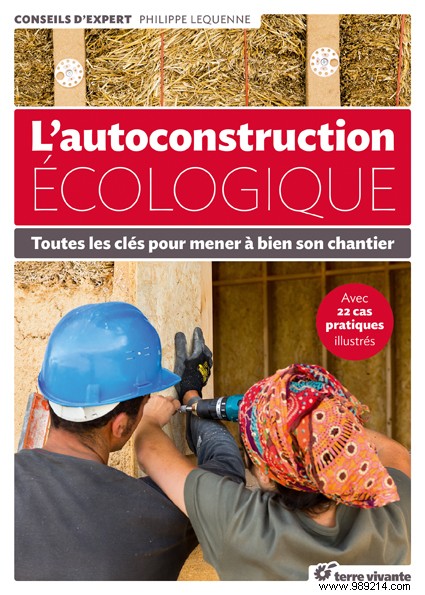
Expert guidance is crucial. "The Ecological Self-Construction" by Philippe Lequenne*, an engineer specializing in architecture and renewable energies, serves as an indispensable resource. This practical manual features over 20 detailed sheets on key project phases, drawn from real cases: foundations, slabs and floors, wall and partition insulation, roofing, joinery and exterior cladding, airtightness and ventilation, solar energy, water systems, electricity, and more. Appendices include curated resources for training, suppliers, and information.
Self-building brings inevitable challenges and moments of doubt—it's part of the process. Surround yourself with supportive family, friends, and self-builder networks for resilience and success.
* Editions Terre Vivante - released November 6, 2015 - €23
