
Cedar hedges offer stunning, year-round evergreen beauty that enhances any landscape.
However, like all shrubs, they require regular maintenance to prevent them from becoming overgrown and unruly.
With their vigorous growth, cedars can quickly gain height and width.
Want proven tips from experienced gardeners? Here's when and how to prune cedar hedges effectively.

A key tip from seasoned pros: Prune your cedars at the end of the day or on overcast days.
Conifers already endure summer sun and heat—pruning during peak sun can stress them further, leading to yellowing as cuts dry out too quickly.
Stick to two ideal windows: early May and mid-August to late September.
Light trims are fine outside these periods, as long as temperatures stay above freezing.
For newly planted young cedars, start pruning early to promote denser growth at the center, keeping hedges compact (around 40cm wide) and easier to maintain.
Cedar branches are relatively thin, making them suitable for both manual shears and powered hedge trimmers.
Electric or gas trimmers save time and effort, especially with a long blade to prevent uneven cuts or gaps.
The hedge top is trickiest—awkward positioning leads to fatigue and safety risks.
Opt for a pole hedge trimmer for safe, easy access, and consider a garden scaffold for stability on taller hedges.
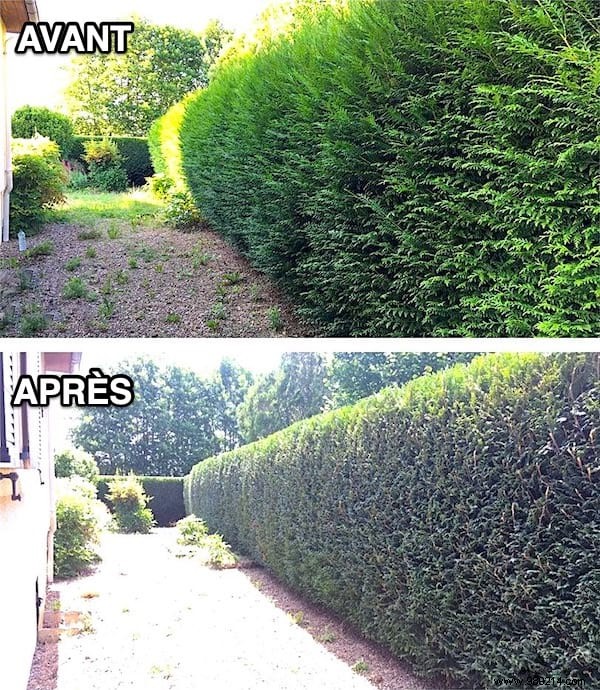
Many gardeners prune vertically for simplicity, creating straight sides from base to top.
However, for dense, vibrant cedars, experts recommend tapering the cut: narrower at the top than the base.
This allows sunlight and water to reach lower branches, fostering stronger, bushier growth throughout.
Pro tip: Water hedges generously a few days before pruning to boost regrowth and density.
Pruning generates plenty of clippings—don't just compost or discard them.
Spread them at the base of your cedars. As they decompose, they form a mulch that retains moisture, benefiting your shrubs' health.
Eco-friendly and practical!